It’s Tone, Not Words

One of the things that has changed over the years with my hearing is my speech. I lost my hearing gradually over about 30 years. My mother and pediatrician  suspected I had hearing loss when I was a child and it was a confirmed diagnosis when I was in my teens. As a young adult the suspicion that it was a progressive loss was determined to be the case. So, in the formative years, I had almost normal hearing and good speech reflecting what I heard. With the progressive loss, I didn’t always know what sounds I was missing. It was the same with my speech. I didn’t realize that my enunciation was changing as I could not hear the consonants I was neglecting to form when I talked. 

My speech changed and no one told me until after I got my cochlear implant. Prior to getting my cochlear implant, my speech was becoming muddled as I was told by my family members. They did not bring that to my attention when it was happening. Had they told me, I probably would have stopped talking. 

After getting my first cochlear implant, my speech began to improve. I was able to distinguish between consonant sounds, hear my own voice and therefore recovered enunciation and clarity when I talked. I had the words.

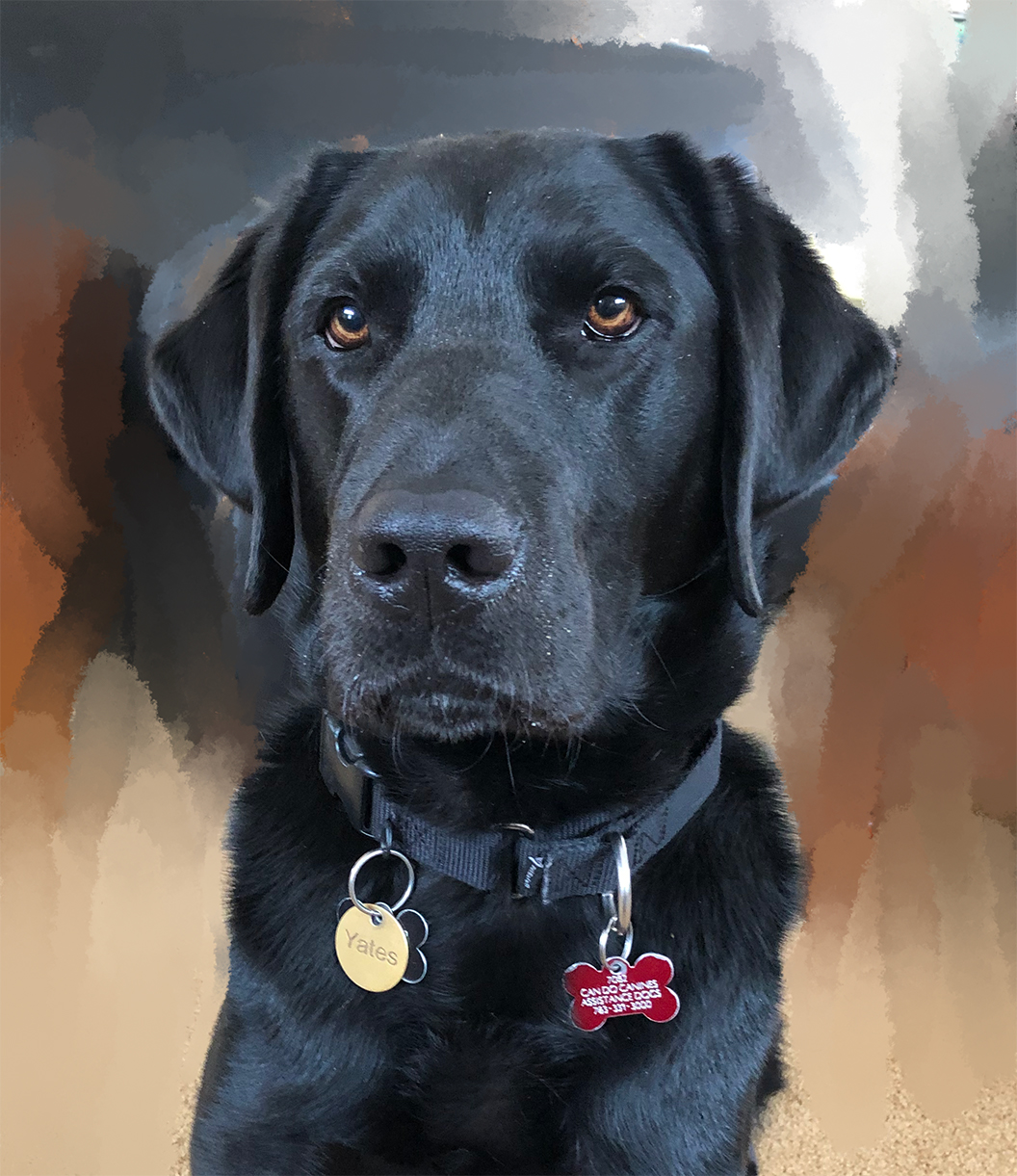
What goes with clear words to make good speech? Intonation. With my cochlear implants I can hear intonation but I hadn’t necessarily applied it to my own manner of speaking. This was brought to my attention when I was training with Yates, my Can-Do-Canines hearing assistance dog. I could say, “Good boy,” but I didn’t add enough cheerfulness and enthusiasm. This was noted by my coaches. They encouraged me to add that to my intonation when rewarding Yates for his proper responses and good behavior. Dogs hear and respond to tone and this is clearly reflected in Yates body language. I can see the difference.

When I speak to Yates with cheerfulness in my voice I can hold his attention. When I add excitement his tail wags harder and he comes in close for a back scratch. Sometimes he needs redirection and the word, “No,” is not effective. Instead I was coached to say, “Anh Anh,” with a tone that is kind of sharp and irritating. This sound usually works. 

I have come to realize that my manner of speaking is more monotone than I thought. So I have worked at adding intonation when I talk to Yates that is compelling to him. This involves lifting my voice into a range I’m not use to hearing from myself. It is fun to see his reaction when I apply more cheerfulness to my speech. He will look at me with bright eyes and interest while sometimes wagging his tail and tilting his head.  The cuteness of those looks is a joy to behold!
A Year Like No Other

Yates has been living with me for one year. We celebrated the anniversary on May 13th which marked the exact day I brought him home. It has been quite a year and I am so grateful I had Yates by my side. 

Lately, on our daily walks I have been reflecting on the last year. At the forefront of my mind has been the fact that when Yates is in his vest, when we are out and about, that says to the public that I have a disability and I am assisted with a Can-Do-Canine. For me, that has probably been the biggest adjustment. I remember when I had my interview with Sarah from Can-Do-Canines and she asked me how I felt about making my invisible disability visible. At the time, I had not really thought a lot about what that would mean to me. I know I tried to assure Sarah that I would be fine with it; however, the experience of actually making it visible had some pluses and minuses for me emotionally.

Some history is needed to understand why that was an adjustment. Around the time that I received the diagnosis that my hearing loss was progressive and I would probably be deaf by the time I was 50, I also discovered by accident that I was lipreading.  Apparently I was unconsciously adjusting to losing my hearing and adapting with visual clues. Eventually I came to rely on lipreading. I wore hearing aids, but they did not give me quality hearing that I could use to decipher speech. During those years, when necessary, I would tell whomever I was communicating with that I needed to see their face so I could read their lips. Thousands of times I had to say, “I’m hearing impaired and read lips.” Fessing up to my disability was something I often had to do, but it wore on me. So it remained invisible as much as I could manage to cover it up.

In 2001, when I was 44, my hearing loss had progressed to severe/profound and I qualified to receive a cochlear implant. It was a relief to have doctors finally say there was something that could be done and might help. The cochlear implant was a great success and gave me sounds that I had not heard in years. In many situations speech sounds were getting through and I could understand more conversation. Life began to change and communication got a lot easier. The cochlear implant eliminated my constant need to tell people that I am hearing impaired and I need to see their face for lip reading. It was great to have more choice on when to reveal my disability because I could get through many situations with the sounds I get from my bionic ears.

As wonderful as my bionic ears are, they are not on all the time. I felt a gap in the independence I had gained from family assistance. I realized I wanted more independence when my “ears” are off and I’m in my silent world. For instance, I wanted to be comfortable traveling by myself. Sleeping in a hotel room without a hearing person present was uncomfortable knowing I would not wake to a smoke alarm, knocking on the door, or a phone ringing. With this in mind I searched for options and found Can-Do-Canines and I applied for a hearing assistance dog. 

I was matched with Yates in May of 2020 and I was able to bring him home on the 13th of May. Also in May of 2020, recommendations to wear face masks to slow the spread of the virus, covid-19, had been made to the public. 

Though I hear well with my cochlear implants masks were muffling speech, and I soon discovered that I still read lips. More so than I realized until I was faced with people everywhere wearing face coverings. Not only did I feel a great disconnect from society, I myself couldn’t wear a face mask. When attempting to shop I was confronted with people asking if I had a mask. More often than not, with their speech muffled by a mask, I could not understand what they were saying. I had to resort to telling them “I read lips”  and in some instances they would pull their mask down to communicate with me. There were other events where I was actually not allowed to enter the store. Stores that I will never shop in again due to their lack of sensitivity to the hearing impaired. 

During the dark days of masks, I was training with Yates to work towards our certification. When we practiced being out in public and would go into stores together, Yates in his cape was a visual clue to the store employees that I have a disability and therefore I was exempt from the mask mandate. I was only asked once if I had a mask when I had Yates with me. People often noticed Yates first and I sometimes could see the smile in their eyes when they saw him with me. 

Making my disability visible this way was hard for me at first. I had many years where I could breeze through an event or activity without revealing that I hear with a cochlear implant system.  I enjoyed not having to share that part of me. On the flip side, making my disability visible through Yates during the mask mandate made things easier for me. Over time and with more public outings with Yates, I relaxed and having Yates with me became a comfort. He eased the stress I felt being in a masked world.

A year like no other has passed. I find myself amazed at God’s timing. He gifted me with Yates.  Yates in his shiny black coat, head held high, and tail wagging has served as a ray of light in a dark time. 

Hearing Assistance Dog

Hello Friends – It has been awhile since I have written for my blog consistently. Seems I settled into a pretty comfortable existence with my bionic hearing and not a lot of new hearing experiences were taking place. Hearing with cochlear implants has been amazing. As wonderful as they are, it is not a full time solution. 

Many years ago I saw a documentary on TV about dogs being trained to assist the hearing impaired. That tidbit of information was in the back of my mind and I thought might be a resource to consider if I ever felt the need. As of late, the idea of having a canine to alert me to sounds I may miss and especially to alert me in the night or morning when I don’t have my CI processors on has made me think it would be a comfort. I would feel more secure knowing a dog would alert me if the smoke alarm is going off or someone has come to the door. The feeling of security for me extended to my family. They like the idea of another set of ears looking out for me and have been very encouraging. With their ongoing support, I began the research for information regarding hearing assistance dogs.

A friend, who volunteers for Can-Do-Canines of Minnesota, talked with me and my husband, Paul, about this organization that trains hearing assistance dogs. He showed me pictures of the dogs he has fostered; irresistible young labradors. After visiting with him, I read through the Can-Do-Canines website and decided to apply for a hearing assistance dog. 

candologoCan-Do-Canines is an excellent organization looking to serve their clients well and make great matches with assistance dogs. The application is thorough and includes an interview which I did via FaceTime. Days after my interview, I received a letter of congratulations accepting me into the program. I was excited and a little anxious as questions began swimming in my head.  What kind of a dog would I be matched with? I grew up with pet dogs – how would a working dog be different? 

While I waited for my match, Can-Do-Canines offered me classes to begin learning about the dogs, their care and training, as well as how the organization works and what my commitments would be. There is much to learn about assistance dogs and I think it will be well worth the effort to feel more secure when I don’t have the presence of a family member. 

Gradual hearing loss has presented many challenges and there have been many assistive devices that helped me through the phases of my hearing loss. Now, I will enter a new exciting phase with a warm-blooded, living helper – a Can-Do-Canine.