Coping with Grief: My Cochlear Implant Journey and Loss of My Spouse

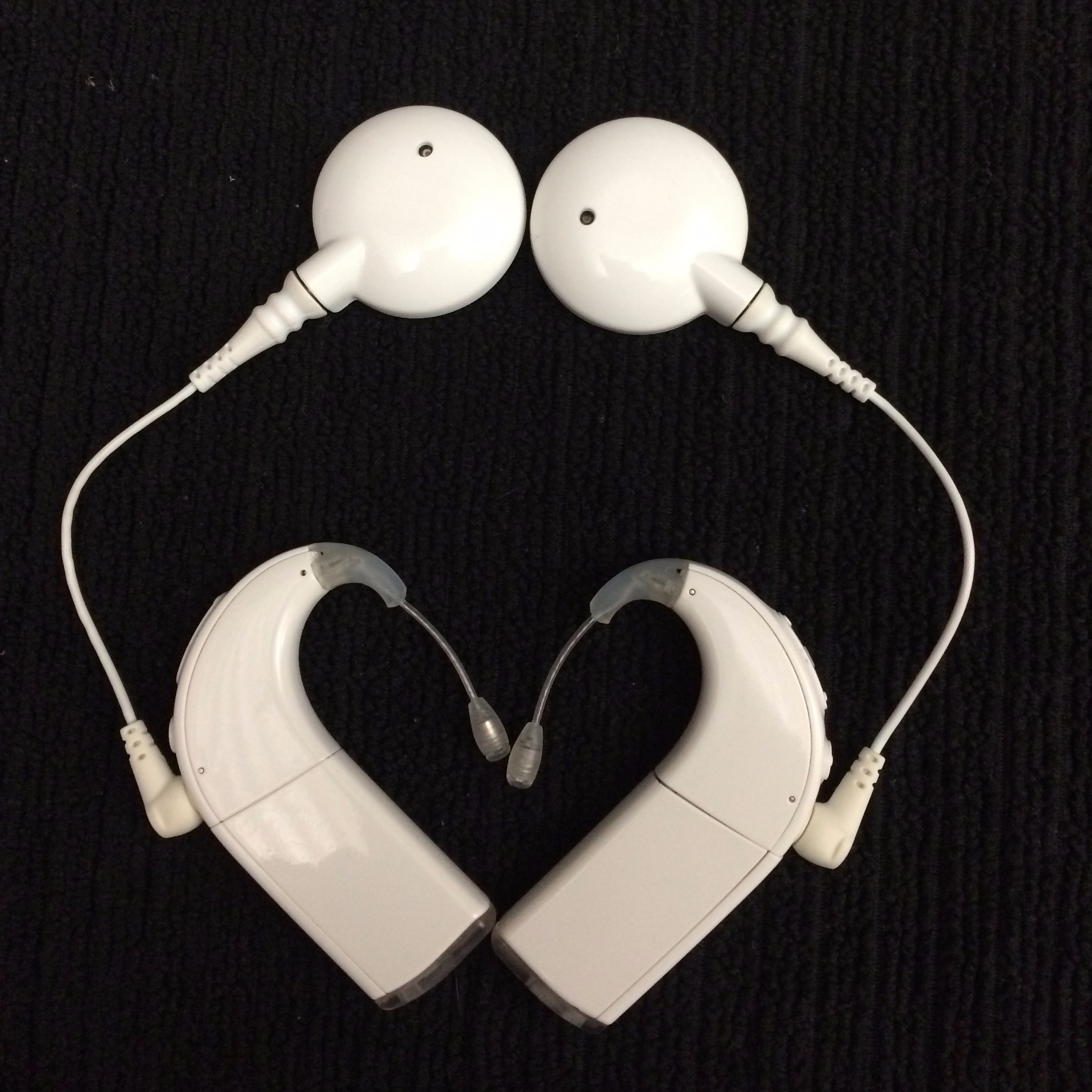
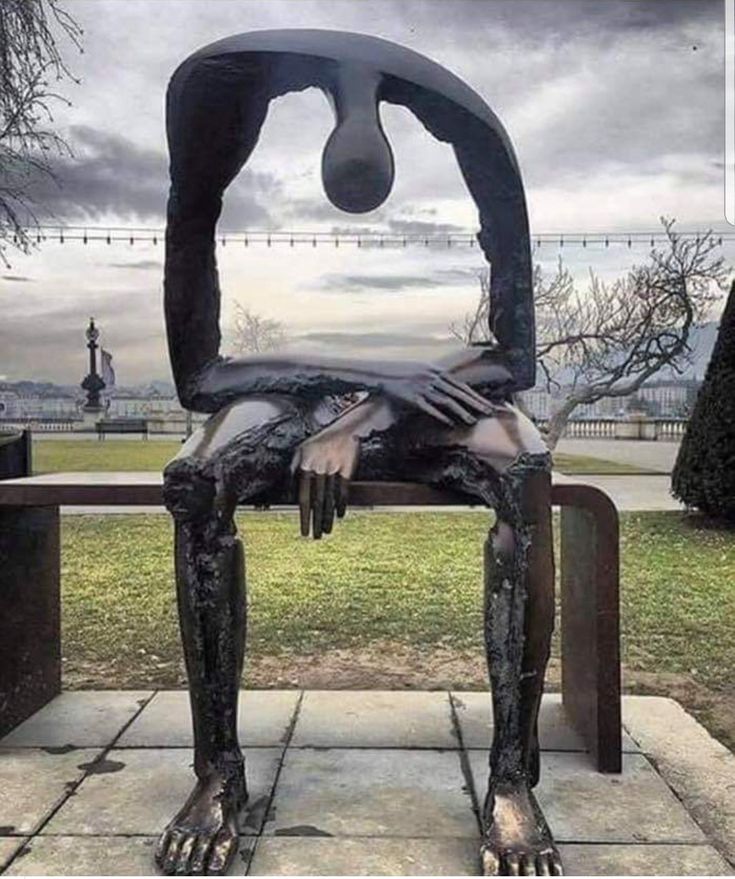
My first post on here is my cochlear implant story titled, “How Many Times Do I Have To Grieve.” With my gradual hearing loss of many years, there were many times I had to face the loss as it accumulated year after year. Now I face the greatest grief of all, the death of my spouse.

Today I had to talk with a city staff person about removing a hedge on the boulevard that Paul used to maintain. It hit me hard. It is another element of the things he did that is going away. The changes and the hits keep on coming. My heart breaks over and over again as he grows further and further away. 

I believe he is in heaven with God. And I trust that God has a plan for me. I pray, I listen and try my best to do His will as I believe He is guiding me. I seek solace in Him, but some days missing Paul is so great that the tears just drip from my face as I try to keep doing life.

The question is no longer, “How many times do I have to grieve?” It is continuous with the loss of my love, my best friend. The question is, “How do I manage this grief?” It is a grief complicated by post traumatic stress due to the way Paul died. I have pursued many tools that have helped on this path. Prayer, first and foremost, several different support groups, music therapy, exercise and nutrition, and the sharing of our story. 

Sharing our story is part of seeking justice for Paul and the many others that died by the hands of the covid hospital protocol. It can be therapeutic to the grief process. I work with Covid Justice MN. As a group we work at getting the information to the uninformed and the deniers. We are seeking truth and to change the protocols that kill.

I know the changes will keep coming, my heart will break again and the tears will flow. I’ll turn to God. He will pick me up and I’ll take another step forward. I’ll think of Paul in heaven and know that God has us where He wants us. With God, I’ll manage this grief.

It’s Time

I have been wanting to change and expand the direction of this blog for quite awhile. The focus of this blog has always been about hearing, losing my hearing, gaining sound with cochlear implants and learning to hear with them. That part of my life has been a medical marvel and remains a constant in my life. Everything else has changed.

My husband Paul, of 44 years, died in a hospital on January 10, 2022. The protocols used by the hospitals to treat COVID-19 patients is what killed him. It is hard to write about, yet I feel I must. What happened to Paul and me has happened to so many others. Victims and survivors are finding each other on social media and at health and freedom events. There are many of us that can speak about the chain of events that killed our loved ones, but sadly, some of us still cannot. It has been clear, however, that listening to our stories has motivated others to come forward, and to share their own tragic experiences. You can find well over a thousand of these heartbreaking and eerily similar stories documented on The FormerFedsGroup Freedom Foundation’s COVID-19 Humanity Betrayal Memory Project ( chbmp.org.)

I was searching for support to help me with my grief and thankfully found The FormerFedsGroup Freedom Foundation (FFFF). When I learned about their COVID-19 Humanity Betrayal Memory Project, it helped me process and deal with my loss. They encouraged me to talk about what happened to Paul and to record my experience to preserve the evidence of what happened and to memorialize Paul. FFFF also offers support groups every day of the week including women’s group, men’s group, PTSD support, art therapy and many others.  All these groups are online so that anyone can join regardless of where they live. This was the kind of support that I desperately needed and could not find with other groups because so many people are unaware that the COVID-19 hospital protocol was really the cause of their loved ones’ deaths. These protocols consist of using deadly experimental drugs that hospitals are financially incentivized to use. It was because of my participation with FFFF, a local group, Covid Justice MN, reached out to me. This group is fighting for justice on behalf of the COVID-19 hospital protocol victims in Minnesota, and I am grateful to be a part of this group of warriors. 

This sound unbelievable? Well, it has happened countless times and still happens to this day. Listen for yourselves on chbmp.org. The government and Big Pharma have turned hospitals into killing factories. Medicine has been corrupted and is not geared towards helping patients. It is profit over patients. Big Pharma does not make cures, they make customers. We must help people wake up and realize this or it will get worse, and more people will die at the hands of these greedy corporations and corrupt bureaucrats. The American people have been gaslit and lied to by our government, the mainstream media and even Hollywood. We have been fed a bunch of dangerous propaganda and the people responsible must be held accountable. 

I speak the truth, but many do not want to hear or want to believe it, it is too hard to accept. The FormerFedsGroup Freedom Foundation has identified 25 commonalities that appear in almost every story. The cruelties in the hospitals include not being fed or given water, isolated, neglected and restrained. Horrific treatment of innocent people so they can collect a big check when that person succumbs to the treatment. The 25 commonalities can be found at: https://chbmp.org/commonalities

My love, my best friend, is in heaven now and that has changed everything for me. At first, I was numb and in shock, but as the shock and numbness wore off, the pain and grief increased. I became aware of what really happened to Paul. Half of me is gone and my life will never be the same. Thankfully, I have support now and I am doing my best to work through my grief. I rely on Jesus and reach out to the many others that have been through the same trauma. God is educating me, moving me, and showing me a part of myself I never imagined. I will follow Him, and I will obey Him. As long as I am here, I will continue to seek the truth and share the truth of what happened to Paul and so many other lives taken too soon. 

Jesus answered, “I am the way and the truth and the life. No one comes to the Father except through me. John 14:6

Dancing Through the Tears 

I have always preserved music in my memory, especially the music I loved before hearing loss made it impossible to learn new songs. Lately I have been playing more music from the early years when I still had most of my hearing. One of those songs has been stuck in my head for the last few days. I haven’t been able to shut it off. The song is, “When Will I See You Again?” by the Three Degrees. 

It’s Christmas time, and I have been prepping for a house full of family on Christmas Eve. Along with the music that keeps playing in my head while I clean, I have been missing my husband, Paul. He died on January 10, 2022. Like the words in the song, I’ve been wondering when will I see him again. The song plays over and over in my head. 

While working in the kitchen, with that song playing in my head, and remembering Paul, a memory of my wonderful husband of 44 years bubbled to the surface of my thoughts. I remember it was Christmastime and earlier that month I had seen my hearing doctor. At the time I had been wearing hearing aids for a few years. At the appointment with my doctor, it was determined that I needed stronger hearing aids, and the deterioration of my hearing did not appear to be slowing down. 

On an evening when I was getting ready for Christmas celebrations doing chores in the kitchen, Paul and his brother started bringing big boxes into the house. Paul wanted to surprise me with a top-of-the-line Bose stereo system. He wanted to give me the gift of music for however much longer I had to hear it. We were raising three daughters, and my first thought was, “Can we afford this?” But that, the budget, isn’t what mattered to Paul. It was a beautiful gift of love. 

That stereo provided great surround sound for many years. When I could, I played it loud and danced through my household chores. Eventually, the lack of hearing made it impossible for me to understand the words of a song. Finally, before I received my first cochlear implant, the only music I enjoyed from the stereo was “Mannheim Steamroller Christmas.” For some reason that style of sound reached me through my deafness, and I’m sure stirred my memory bank of songs enough for me to enjoy it. 

I have had bilateral cochlear implants now for many years. When I got my first implant, the goal was to learn to hear speech and relieve the work of lip reading. I did rehabilitation exercises to learn to hear again and to be able to hear on the phone. After I mastered the phone, I wanted music again. Listening to songs from my good hearing days, sometimes over and over, brought the enjoyment of music back to me. Paul was there for me, every step of the way, always supportive. He would be so happy for me and the hearing system I have now. My latest cochlear implant processors have Bluetooth. When I play music on my phone, it goes directly to my hearing system, and I hear it like I did before deafness. When I’m missing ‘Paul my own’ and remembering us through the years, I’ll put on some music and find myself dancing through the tears.

It’s Tone, Not Words

One of the things that has changed over the years with my hearing is my speech. I lost my hearing gradually over about 30 years. My mother and pediatrician  suspected I had hearing loss when I was a child and it was a confirmed diagnosis when I was in my teens. As a young adult the suspicion that it was a progressive loss was determined to be the case. So, in the formative years, I had almost normal hearing and good speech reflecting what I heard. With the progressive loss, I didn’t always know what sounds I was missing. It was the same with my speech. I didn’t realize that my enunciation was changing as I could not hear the consonants I was neglecting to form when I talked. 

My speech changed and no one told me until after I got my cochlear implant. Prior to getting my cochlear implant, my speech was becoming muddled as I was told by my family members. They did not bring that to my attention when it was happening. Had they told me, I probably would have stopped talking. 

After getting my first cochlear implant, my speech began to improve. I was able to distinguish between consonant sounds, hear my own voice and therefore recovered enunciation and clarity when I talked. I had the words.

What goes with clear words to make good speech? Intonation. With my cochlear implants I can hear intonation but I hadn’t necessarily applied it to my own manner of speaking. This was brought to my attention when I was training with Yates, my Can-Do-Canines hearing assistance dog. I could say, “Good boy,” but I didn’t add enough cheerfulness and enthusiasm. This was noted by my coaches. They encouraged me to add that to my intonation when rewarding Yates for his proper responses and good behavior. Dogs hear and respond to tone and this is clearly reflected in Yates body language. I can see the difference.

When I speak to Yates with cheerfulness in my voice I can hold his attention. When I add excitement his tail wags harder and he comes in close for a back scratch. Sometimes he needs redirection and the word, “No,” is not effective. Instead I was coached to say, “Anh Anh,” with a tone that is kind of sharp and irritating. This sound usually works. 

I have come to realize that my manner of speaking is more monotone than I thought. So I have worked at adding intonation when I talk to Yates that is compelling to him. This involves lifting my voice into a range I’m not use to hearing from myself. It is fun to see his reaction when I apply more cheerfulness to my speech. He will look at me with bright eyes and interest while sometimes wagging his tail and tilting his head.  The cuteness of those looks is a joy to behold!

A Year Like No Other

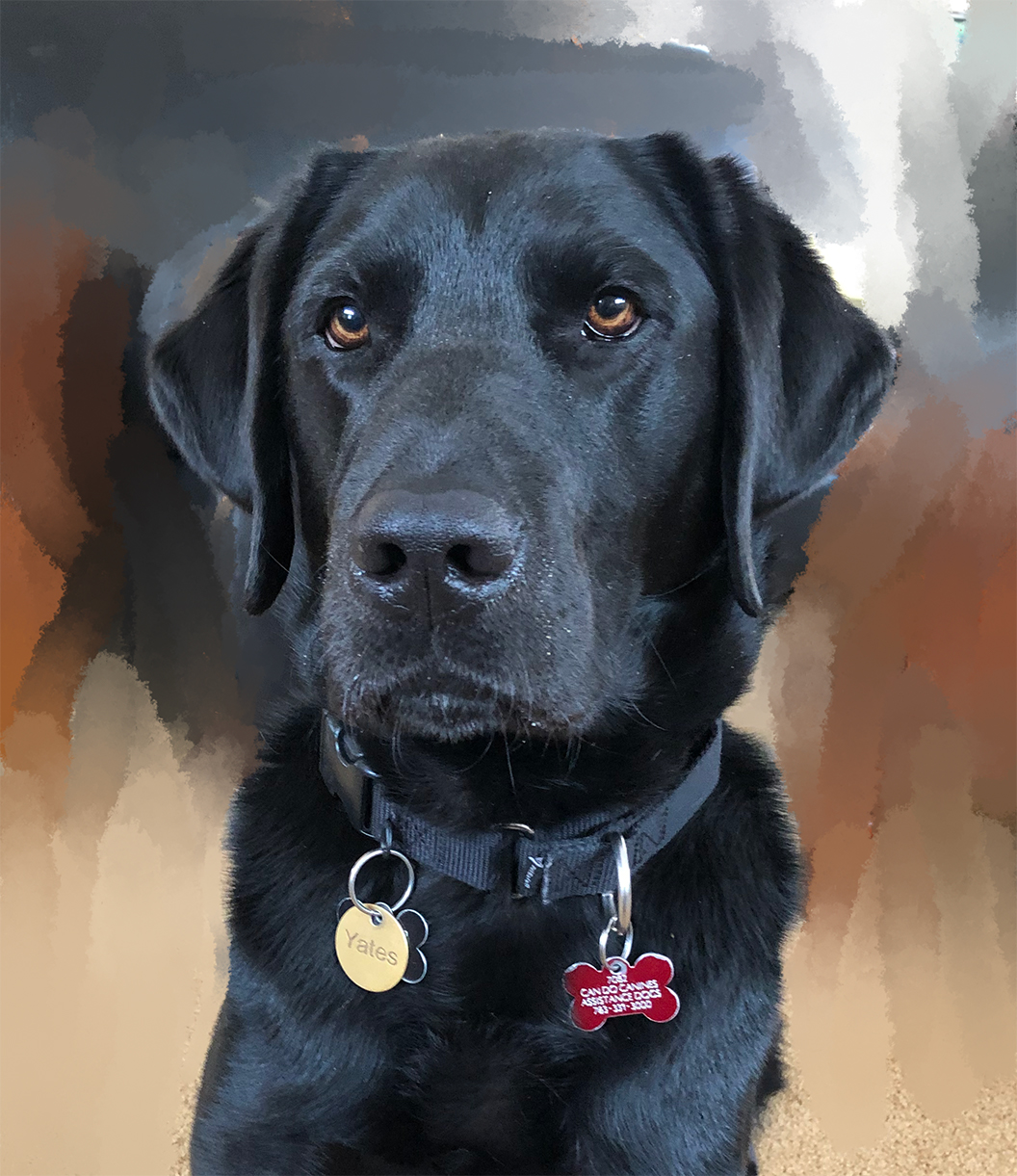
Yates has been living with me for one year. We celebrated the anniversary on May 13th which marked the exact day I brought him home. It has been quite a year and I am so grateful I had Yates by my side. 

Lately, on our daily walks I have been reflecting on the last year. At the forefront of my mind has been the fact that when Yates is in his vest, when we are out and about, that says to the public that I have a disability and I am assisted with a Can-Do-Canine. For me, that has probably been the biggest adjustment. I remember when I had my interview with Sarah from Can-Do-Canines and she asked me how I felt about making my invisible disability visible. At the time, I had not really thought a lot about what that would mean to me. I know I tried to assure Sarah that I would be fine with it; however, the experience of actually making it visible had some pluses and minuses for me emotionally.

Some history is needed to understand why that was an adjustment. Around the time that I received the diagnosis that my hearing loss was progressive and I would probably be deaf by the time I was 50, I also discovered by accident that I was lipreading.  Apparently I was unconsciously adjusting to losing my hearing and adapting with visual clues. Eventually I came to rely on lipreading. I wore hearing aids, but they did not give me quality hearing that I could use to decipher speech. During those years, when necessary, I would tell whomever I was communicating with that I needed to see their face so I could read their lips. Thousands of times I had to say, “I’m hearing impaired and read lips.” Fessing up to my disability was something I often had to do, but it wore on me. So it remained invisible as much as I could manage to cover it up.

In 2001, when I was 44, my hearing loss had progressed to severe/profound and I qualified to receive a cochlear implant. It was a relief to have doctors finally say there was something that could be done and might help. The cochlear implant was a great success and gave me sounds that I had not heard in years. In many situations speech sounds were getting through and I could understand more conversation. Life began to change and communication got a lot easier. The cochlear implant eliminated my constant need to tell people that I am hearing impaired and I need to see their face for lip reading. It was great to have more choice on when to reveal my disability because I could get through many situations with the sounds I get from my bionic ears.

As wonderful as my bionic ears are, they are not on all the time. I felt a gap in the independence I had gained from family assistance. I realized I wanted more independence when my “ears” are off and I’m in my silent world. For instance, I wanted to be comfortable traveling by myself. Sleeping in a hotel room without a hearing person present was uncomfortable knowing I would not wake to a smoke alarm, knocking on the door, or a phone ringing. With this in mind I searched for options and found Can-Do-Canines and I applied for a hearing assistance dog. 

I was matched with Yates in May of 2020 and I was able to bring him home on the 13th of May. Also in May of 2020, recommendations to wear face masks to slow the spread of the virus, covid-19, had been made to the public. 

Though I hear well with my cochlear implants masks were muffling speech, and I soon discovered that I still read lips. More so than I realized until I was faced with people everywhere wearing face coverings. Not only did I feel a great disconnect from society, I myself couldn’t wear a face mask. When attempting to shop I was confronted with people asking if I had a mask. More often than not, with their speech muffled by a mask, I could not understand what they were saying. I had to resort to telling them “I read lips”  and in some instances they would pull their mask down to communicate with me. There were other events where I was actually not allowed to enter the store. Stores that I will never shop in again due to their lack of sensitivity to the hearing impaired. 

During the dark days of masks, I was training with Yates to work towards our certification. When we practiced being out in public and would go into stores together, Yates in his cape was a visual clue to the store employees that I have a disability and therefore I was exempt from the mask mandate. I was only asked once if I had a mask when I had Yates with me. People often noticed Yates first and I sometimes could see the smile in their eyes when they saw him with me. 

Making my disability visible this way was hard for me at first. I had many years where I could breeze through an event or activity without revealing that I hear with a cochlear implant system.  I enjoyed not having to share that part of me. On the flip side, making my disability visible through Yates during the mask mandate made things easier for me. Over time and with more public outings with Yates, I relaxed and having Yates with me became a comfort. He eased the stress I felt being in a masked world.

A year like no other has passed. I find myself amazed at God’s timing. He gifted me with Yates.  Yates in his shiny black coat, head held high, and tail wagging has served as a ray of light in a dark time. 

A New Sound! Clippity Clop.

It is warming up here. Yesterday it felt nice enough to get Yates out for a walk. I made sure he had his boots on to protect his paws and that it was warm enough to feel comfortable that his ears and tail would not get frostbite. 

Often I will put on my FM neck loop that sends a signal to my implant processors that have a built in telecoil to catch the signal. I plug the FM loop into my phone and wear the loop around my neck. With this system I can listen to my favorite tunes when we walk. (For you hearing readers, this is what I use in place of ear buds or a headset.) My processors are set to deliver  50% telecoil signal and 50% microphone signals so that I still get environmental sound. My audiologist felt it was important to not shut out the environment completely and a 100% telecoil setting would do that. Even so, on this day, since Yates and I had not been on a walk for a few days, I decided to leave the music off and just listen to Yates and the world. 

Yates was a little reluctant at first about getting his boots put on. With encouragement and cookie rewards, he cooperated. When all four paws were covered, he stood up and seemed ready to get outside and walking. The sun was shining and with no wind, it felt pretty good to be out of the house. 

Boots on – ready to go!

Out the door and on our way, we headed towards the neighborhood school where I knew the path and sidewalks were dry. On the street we stayed close to the curb and in the snow to avoid ice. Once we got to the dry path, we picked up our pace and Yates trotted along. Without music to distract me, I listened to our walk and there was a new sound. Clop, clop, clop, clop, clippity clop, clop, clop, clop – it sounded like I had a little pony trotting beside me! Enjoying his walk and briskly stepping along, it was Yates boots as they tapped the dry pavement. Oh how fun! Something new, something different and a reminder of my Joy in Hearing! I smiled to myself and savored the sound.

As the days get warmer, Yates will wear boots on our walks until it is 20 degrees above as that seems to be the temperature at which he doesn’t display cold paws by stopping and holding them up. We will clop, clop, clop along, listening to our own little song of walking in the neighborhood – grateful for dry paths and the varied sounds of life-making music.

Yates Wears Boots

I try to get Yates out for a walk every day. We shoot for three miles a day and usually can manage that. In November, December and January, we enjoyed mild winter temperatures making it possible for Yates and me to go on long walks. But – it is Minnesota and the cold temperatures were looming. 

I consulted our training coaches regarding cold weather walks with Yates as I was looking at boots for Yates and wanted to be sure it would be worth trying. Elizabeth shared very good detailed information about cold weather paw protection.  About a week before the cold snap hit, I ordered boots for Yates. They arrived just as the weather was turning colder.

Prepared with cookies and patience, I worked with Yates to get them on his paws. Although I don’t think it is kind to laugh at dogs or children, it was comical. My daughter was watching and she took some video. 

That first day, I couldn’t get Yates out of the driveway. We went inside, took his boots off and did a short walk. It was short because his paws were cold, he started lifting them so we had to go home.  On the second day it was easier to get his boots on and we managed to go around the block. With this walk he was discovering that he could walk normally. On the third day we went around a bigger block. He seemed to be getting more comfortable in his boots. The fourth day we headed for one of his favorite walks around the neighborhood school. He seemed to be enjoying himself; however it was just too cold and he started nudging me before we got very far. We turned around and headed home. 

Yesterday was pretty cold and I had been playing with Yates and thinking I would take him to a big box store in the evening if he was really restless. At around 4:00 pm he was really working at me for attention. I said to my daughter, “He really wants to go for a walk.” I got his boots out. There was absolutely no resistance from Yates when I was putting them on. He wanted his walk. So – with  boots on Yates and myself bundled up we headed for the path around the school. Yates trotted right along and made a few stops at his favorite sniffing spots. We managed to get around the whole block and then home, totaling 1.5 miles. 

We will get through this cold snap and still get some exercise and fresh air. Bundled up and boots on, there is no stopping us. Happy Winter!

No Confusion for Hearing Assistance Dog

When I qualified for a hearing assistance dog through Can Do Canines, one of my first concerns was that my situation would be confusing for the dog. You see, I hear very well with my cochlear implants (CIs) which are on and activated most of my waking hours. When they are off, I am completely deaf. I take them off for bathing and sleep.  The trainers I worked with assured me that what we needed to do was train for sounds I would need to be alerted to if my cochlear implant processors were off. Through the training process, even though I was hearing with my (CIs), I ignored the sounds and allowed Yates, my hearing assistance dog (HAD) to alert me. 

We trained at home and in my community for several months after Yates came to live with me. It all went very well. Yates learned to alert me to my phone, the doorbell, a door knock, my alarm clock, a timer, the smoke alarm and a dropped item. My favorite is the alarm clock, because it is true to my need. My CIs are off, I’m without sound and have to trust Yates completely to do his job – And he does. 

I haven’t noticed that Yates suffers from any confusion about when I hear and when I don’t. On the other side of that, I have not seen any indicators that he has figured out when my CIs are on or off.  I do believe he has figured out when I’m awake in the morning. I don’t always use an alarm clock and will sometimes lay in bed after I wake thinking about things before I rise. Occasionally, Yates will put his front paws and head on my chest as if to say, “That’s enough already, time to get up.” He has never done this when I am asleep and will only wake me from sleep when I have set the alarm.

I thank God for bringing Yates into my life. He truly shined a light in a time when it was greatly needed. Working on training; Yates and I caring for each other; and long walks for exercise are all positive things that have helped in keeping 2020 a healthy year for me in all aspects. I don’t see confusion from Yates, but every once in a while, he will give his head the cutest little tilt when he is just a little puzzled. 

Hearing Assistance Dog – Can Do Canine

If you are a cochlear implant user like I am, then you know that it is not a 24/7 fix to hear. Processors come off for sleep and bathing and leave you with the sounds of silence. Not being able to hear my phone or the smoke alarm in the night made me uncomfortable and dependent on always being with someone that could hear.  It was this discomfort that led me to apply for a hearing assistance dog. I had learned about Can-Do-Canines, an organization that trains assistance dogs here in my home state of Minnesota, and that is where I submitted an application. 

Before I was matched, Can-Do-Canines had started offering in-house training classes. I attended two days of classes to prepare for owning and caring for an assistance dog. This was good because I had not lived with a dog since I was a child. Having a childhood pet is a very different scenario from having an assistance dog. So while I waited for the match, I learned what to expect.

IMG_0200In May I was informed that I had been matched with a Can-Do-Canine. Upon receiving this exciting news I wanted to know all about the dog. My Client Services Coordinator, Elizabeth, informed me that his name is Yates, he is a 3 year old black lab and trainers and foster parents had labeled him a “sweet boy.” An appointment was set up for me to meet him and start training with him. I met him on a Wednesday in the middle of May and to my surprise and joy – I was told he could go home with me that day. This was possible because of the in-house training I had previously and due to extenuating circumstances at the time.  With some thought and a few adjustments to my schedule, Elizabeth and I made a plan for the trip home. Yates came with lots of goodies. There was a kennel, leashes, toys, food and a training cape. Elizabeth helped me load my car and get Yates settled for the 70 mile ride home. 
I had called Paul, my husband, to let him know I was coming home with Yates. He agreed it was exciting news and made sure he was home to greet us. While I showed Yates the house and allowed him to explore his new surroundings, Paul unloaded the car and set up Yates’ kennel. Once we were settled, I contacted the Field Trainer, Nancy, to set up our first at home training sessions. Yates had many basics already mastered and a good start on sound alerts. The next steps involved Yates and I getting to know each other and then learning to recognize the sounds in our home that he should react to and whom he should alert. 

Training sessions and daily walks with Yates were added to a summer filled with family activities. Together Yates and I progressed towards our graduation goals. We practiced sound alerts at home, and in the community we practiced visiting public spaces. He is a pro with commands such as “park” (he backs into and lays down under the chair I’m sitting in)  and “go under” (laying down under the table when I’m dining).

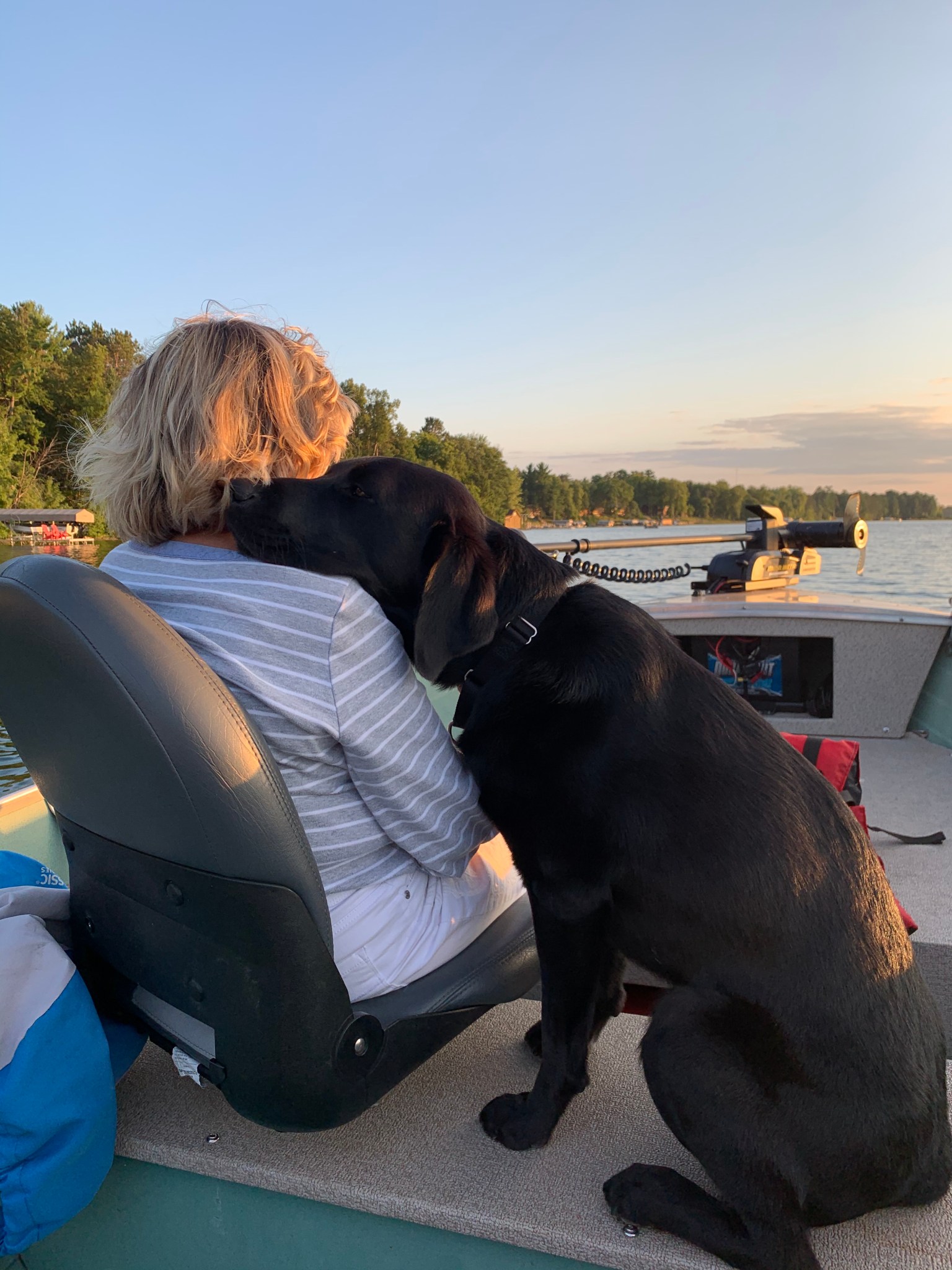
E074FB36-8774-4344-8AEB-49CD4E03748CIt hasn’t been all work. He enjoys tugging a toy, or I hide a toy and he finds the toy. He also enjoys cuddling in the big chair. When we are at the cabin, he enjoys boat rides, wading in the water and fetching floating rock toys. 

We have had a couple of nights on our own since Yates has come to live with me.  It truly is a comfort to know that he will alert me if my phone should ring in the night or if the smoke alarm were triggered. I can set my alarm and I know he will wake me. It is pretty nice to be awakened by a happy tail-wagging friend versus an electronic bed shaker. 

Can-Do-Canines is exemplary in the services they provide. I am so grateful to be a candologorecipient of one of their hearing assistance dogs. So many people play parts in preparing the dogs for their assistance careers. It is a challenge to express the greatness of the gratitude. To the many people that participate; employees, volunteers, trainers and board members, I say THANK YOU! THANK YOU! THANK YOU! 

Hearing Assistance Dog

Hello Friends – It has been awhile since I have written for my blog consistently. Seems I settled into a pretty comfortable existence with my bionic hearing and not a lot of new hearing experiences were taking place. Hearing with cochlear implants has been amazing. As wonderful as they are, it is not a full time solution. 

Many years ago I saw a documentary on TV about dogs being trained to assist the hearing impaired. That tidbit of information was in the back of my mind and I thought might be a resource to consider if I ever felt the need. As of late, the idea of having a canine to alert me to sounds I may miss and especially to alert me in the night or morning when I don’t have my CI processors on has made me think it would be a comfort. I would feel more secure knowing a dog would alert me if the smoke alarm is going off or someone has come to the door. The feeling of security for me extended to my family. They like the idea of another set of ears looking out for me and have been very encouraging. With their ongoing support, I began the research for information regarding hearing assistance dogs.

A friend, who volunteers for Can-Do-Canines of Minnesota, talked with me and my husband, Paul, about this organization that trains hearing assistance dogs. He showed me pictures of the dogs he has fostered; irresistible young labradors. After visiting with him, I read through the Can-Do-Canines website and decided to apply for a hearing assistance dog. 

candologoCan-Do-Canines is an excellent organization looking to serve their clients well and make great matches with assistance dogs. The application is thorough and includes an interview which I did via FaceTime. Days after my interview, I received a letter of congratulations accepting me into the program. I was excited and a little anxious as questions began swimming in my head.  What kind of a dog would I be matched with? I grew up with pet dogs – how would a working dog be different? 

While I waited for my match, Can-Do-Canines offered me classes to begin learning about the dogs, their care and training, as well as how the organization works and what my commitments would be. There is much to learn about assistance dogs and I think it will be well worth the effort to feel more secure when I don’t have the presence of a family member. 

Gradual hearing loss has presented many challenges and there have been many assistive devices that helped me through the phases of my hearing loss. Now, I will enter a new exciting phase with a warm-blooded, living helper – a Can-Do-Canine.